
What is the shielding principle of the M series circular connectors?
What is the shielding principle of the M series circular connectors?
Introduction
In modern industrial automation, reliable electrical connections are essential for accurate signal transmission, stable communication, and equipment performance. Motors, variable-frequency drives, switching power supplies, and industrial communication systems can generate electromagnetic interference (EMI), potentially affecting sensitive electrical signals. Understanding the shielding principle of the connector helps engineers select suitable circular connectors for demanding industrial environments.
M series circular connectors, including M5, M8, M12, and M16 types, are widely used in sensors, actuators, industrial control equipment, and data communication systems. Depending on their construction, shielded versions can help reduce electromagnetic coupling by combining conductive connector shells, compatible cable shields, and properly designed shield termination.
This guide explains the shielding mechanism of M series circular connectors, compares shielded and unshielded designs, and outlines practical selection considerations. It also introduces CONNODER , a manufacturer of industrial circular connectors and connectivity solutions.
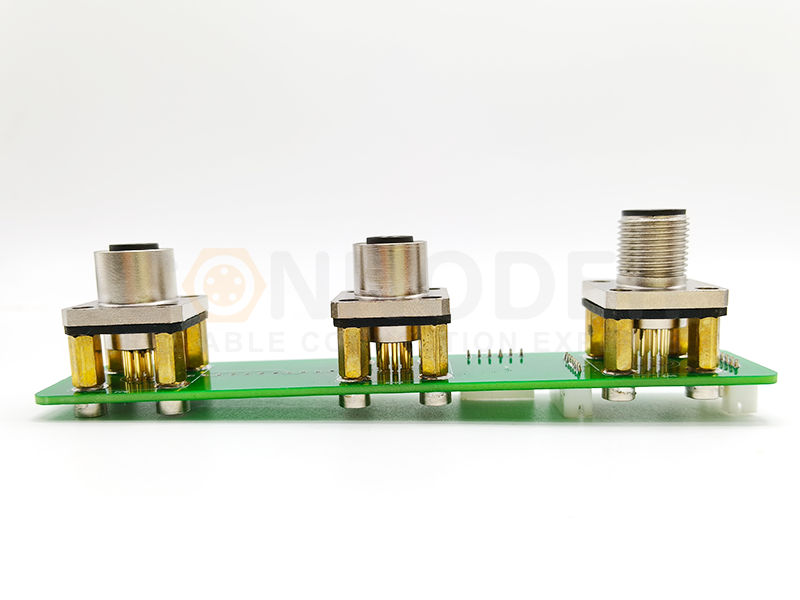
Circular Connectors
Rugged, compact and versatile — ideal when you need mixed power & signal plus environmental protection.
What Is the Shielding Principle of the Connector?
How Does Shielding Work in M Series Circular Connectors?
Shielded vs. Unshielded M Series Circular Connectors
Shielded and unshielded circular connectors serve different application requirements. The correct choice depends on the electromagnetic environment, signal sensitivity, cable construction, installation conditions, and applicable system specifications.
| Feature | Shielded Connector | Unshielded Connector |
|---|---|---|
| Shield construction | Designed with a conductive shielding path | Does not provide a complete connector shield path |
| EMI protection | Can reduce electromagnetic coupling when correctly implemented | Generally offers less shielding against external EMI |
| Signal integrity | Can improve noise immunity in suitable applications | May be sufficient in low-noise environments |
| Installation | Requires appropriate shield termination and bonding | Often simpler when no shield connection is required |
| Cost and complexity | May involve additional components and assembly steps | Often more economical |
| Typical applications | Industrial Ethernet, noise-sensitive signals, electrically noisy environments | Basic sensors, simple I/O, and applications without stringent shielding requirements |
When Should You Choose a Shielded Connector?
What Factors Affect Connector Shielding Effectiveness?
How to Select the Right Shielded Circular Connector
Conclusion
The shielding principle of the connector is based on creating an effective conductive barrier and maintaining a suitable shielding path throughout the connection system. For M series circular connectors, performance depends on the interaction between the connector shell, cable shield, termination method, mating interface, and equipment bonding.
By understanding these factors, engineers can make more informed decisions when selecting shielded M5, M8, M12, and M16 connectors for industrial automation and communication applications.
CONNODER offers a range of industrial circular connector solutions to support different application requirements. By confirming product-specific shielding capabilities and matching connector configurations to real operating conditions, customers can work toward reliable, application-appropriate connectivity.
Connector service life


Tell us the questions you need to consult
Connoder Technology Electronics Co., Ltd.
You can also contact us directly in the following ways: visit, telephone, email
- No.31, Xinle Road, Usha, Chang'an Town, Dongguan City, Guangdong Province
- +86 18128664239
- sale@connoder.com
- https://www.noderconn.com/
 telephone
 Contact US